05
IPv4 vs IPv6: What's the Difference?
"IPv4 vs IPv6, what's actually different? Compare address formats, speed, and security in plain, simple terms."
IPv4 vs IPv6: What's the Difference?
Every device that communicates over an IP network needs addressing information. For many years, IPv4 has been the most familiar version of the Internet Protocol. But as the number of internet-connected devices increased, the limitations of IPv4 became more obvious.
That's where IPv6 comes in.
IPv4 and IPv6 are both versions of the Internet Protocol, but they use different address formats and provide very different numbers of available addresses.
Understanding IPv4 vs IPv6 is useful if you're learning networking, troubleshooting an internet connection, managing a website, or simply trying to understand what an IP checker is showing you.
What Is IPv4?
IPv4 stands for Internet Protocol version 4.
It is one of the main protocols used to identify devices and route network traffic.
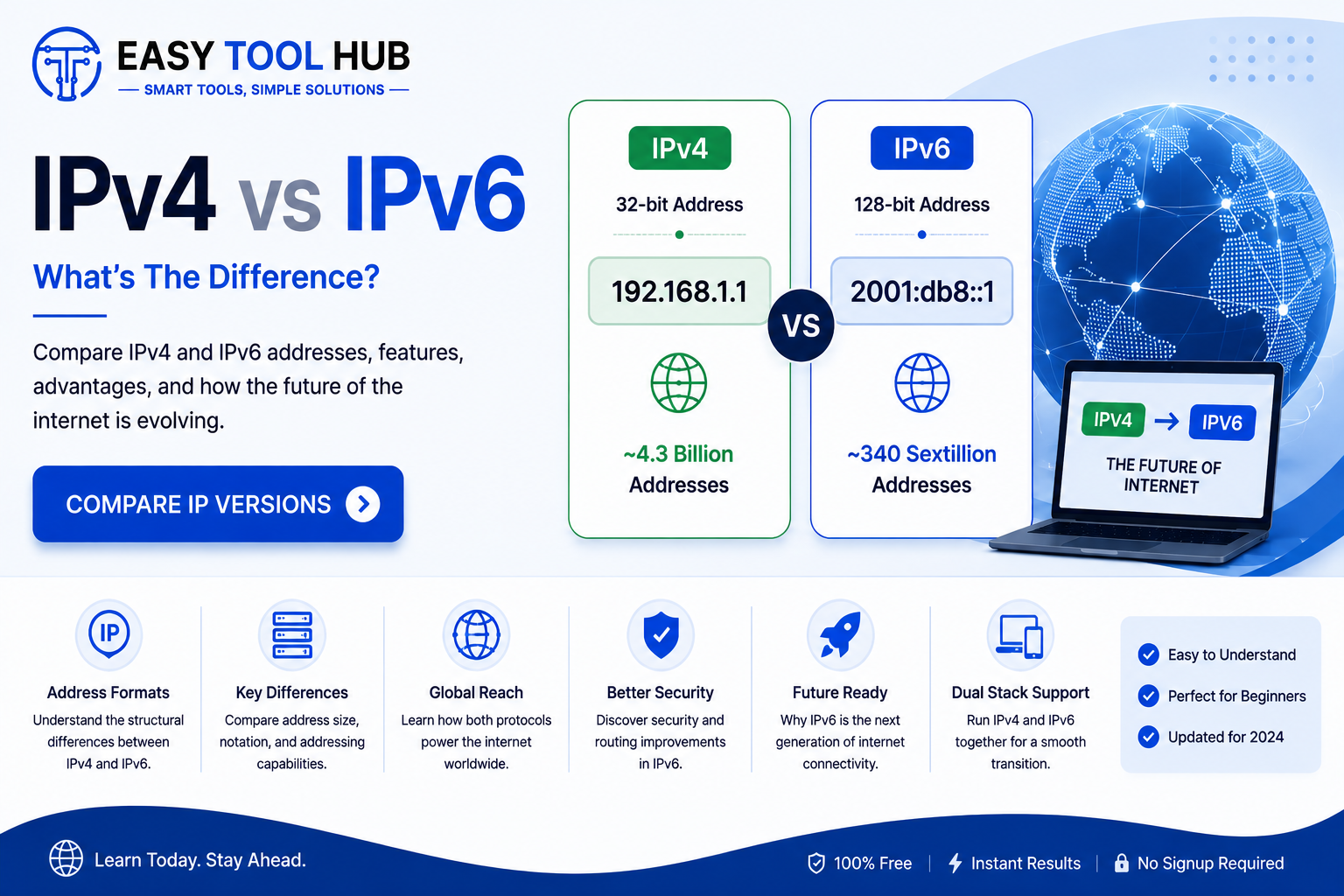
IPv4 uses 32-bit addresses.
An IPv4 address is normally written as 4 decimal numbers separated by periods.
For example:
192.168.1.1
Another example is:
8.8.8.8
Each section is called an octet and can contain a value from 0 through 255.
Because IPv4 uses 32 bits, the theoretical address space contains approximately 4.3 billion possible addresses.
That sounds like a huge number, but the internet eventually grew beyond what could comfortably be supported by globally unique IPv4 addresses.
What Is IPv6?
IPv6 stands for Internet Protocol version 6.
It was developed to provide a much larger address space.
IPv6 uses 128-bit addresses.
An IPv6 address uses hexadecimal characters and is divided into groups separated by colons.
For example:
2001:db8:85a3::8a2e:370:7334
Compared with IPv4, IPv6 provides an enormous number of possible addresses.
This makes it possible to support the continued growth of internet-connected devices without relying entirely on IPv4 address-sharing techniques.
IPv4 vs IPv6 Address Format
The most obvious difference is how the addresses look.
An IPv4 address might look like:
192.168.1.25
An IPv6 address might look like:
2001:db8:1234::1
IPv4 uses decimal numbers separated by periods.
IPv6 uses hexadecimal values separated by colons.
IPv6 addresses can also use shorthand notation to make them shorter.
For example, consecutive groups of zeros can sometimes be compressed using ::.
Why Was IPv6 Created?
One of the biggest reasons IPv6 was created was the limited number of IPv4 addresses.
The internet expanded rapidly. More computers, smartphones, servers, cameras, televisions, appliances, and other devices started connecting to networks.
IPv4's approximately 4.3 billion address combinations were not enough to provide a unique public address for every device that might need one.
Technologies such as NAT helped extend the usefulness of IPv4 by allowing multiple private devices to share public IPv4 addresses.
But IPv6 provides a much larger address space directly.
IPv4 vs IPv6 Address Size
This is one of the biggest technical differences.
IPv4 uses:
32 bits
IPv6 uses:
128 bits
The difference is enormous.
IPv4 has about 4.3 billion possible addresses.
IPv6 has approximately 3.4 × 10³⁸ possible addresses.
The IPv6 address space is so large that it provides a vastly greater number of addresses than IPv4.
Does IPv6 Replace IPv4?
Not immediately.
IPv4 and IPv6 have existed alongside each other for many years.
Many networks still use IPv4, while others support IPv6.
Some devices and networks support both.
This is commonly called dual-stack operation.
Dual-stack allows a device to communicate using IPv4 and IPv6 depending on what is available and supported by the destination and network.
What Is Dual Stack?
Dual stack means a device or network supports both IPv4 and IPv6.
For example, your computer could have:
- An IPv4 address
- An IPv6 address
When you access an online service, the system can determine which protocol is appropriate based on network and destination support.
This approach has helped make the transition from IPv4 to IPv6 more practical.
IPv4 vs IPv6 and NAT
NAT is heavily associated with IPv4 networks.
Because public IPv4 addresses are limited, many home and business networks use private IPv4 addresses internally.
NAT allows multiple private devices to share a public IPv4 address.
IPv6 reduces the need for this type of address sharing because the IPv6 address space is extremely large.
That doesn't mean every IPv6 network works without firewalls or other security systems. Network administrators still need to control which connections are allowed.
Is IPv6 Faster Than IPv4?
IPv6 is not automatically faster simply because it is newer.
Actual network performance depends on many factors, including your ISP, routing, server location, network configuration, congestion, and the services you're accessing.
In some situations IPv6 can provide efficient routing and avoid certain IPv4-related mechanisms. In other situations, IPv4 may perform similarly or better.
Therefore, it isn't accurate to say that IPv6 is always faster than IPv4.
Is IPv6 More Secure Than IPv4?
IPv6 was designed with modern networking requirements in mind and includes capabilities related to security and address configuration.
However, using IPv6 does not automatically make a network secure.
Security still depends on firewalls, device configuration, software updates, authentication, network architecture, and other security controls.
An incorrectly configured IPv6 network can still have security problems.
How Can I Check If I Have IPv4 or IPv6?
One of the easiest ways is to use an online IP information or What's My IP tool.
If the result contains an address such as:
203.0.113.10
that's an IPv4-style address.
If it contains something like:
2001:db8::1
that's an IPv6 address.
Some connections may display both.
Why Does My IP Checker Show Both IPv4 and IPv6?
Your internet connection may support both protocols.
If your device and ISP have IPv6 enabled alongside IPv4, an IP information tool may be able to detect both.
This is normal and is often a sign that your network supports dual-stack connectivity.
The exact result depends on your device, ISP, router, operating system, and network configuration.
IPv4 vs IPv6 for Websites
Website owners need to consider both protocols when managing network infrastructure.
A website can be configured to work over IPv4, IPv6, or both.
DNS plays an important role here.
An A record is commonly used to associate a domain with an IPv4 address.
An AAAA record is used for IPv6 addresses.
For example, a domain can have an A record pointing to an IPv4 server address and an AAAA record pointing to an IPv6 server address.
IPv4 A Record vs IPv6 AAAA Record
The difference is simple:
A record → IPv4
AAAA record → IPv6
When a DNS lookup is performed, these records can help determine which IP addresses are associated with a domain.
This is one reason DNS and IP addressing are closely connected.
Why Does IPv6 Use Letters?
IPv6 addresses are written using hexadecimal notation.
Hexadecimal uses:
0–9
and:
a–f
This allows large binary values to be represented more compactly.
For example:
2001:db8::1
contains hexadecimal values rather than only decimal numbers.
Although IPv6 addresses can look complicated at first, the format becomes easier to recognize with practice.
Can IPv4 and IPv6 Communicate Directly?
IPv4 and IPv6 are different protocols, so they are not simply interchangeable.
Communication between IPv4-only and IPv6-only systems may require transition mechanisms, gateways, translation technologies, or dual-stack support.
Modern networks can use different approaches depending on their infrastructure.
This is one reason the transition to IPv6 has taken many years.
IPv4 vs IPv6 for Home Users
Most home users don't need to manually configure IP protocols.
Your ISP and router generally handle much of the network configuration automatically.
You may see an IPv4 address, IPv6 address, or both when checking your connection.
If your websites and applications work normally, there may be no reason to change anything.
However, understanding the difference can help when troubleshooting connectivity issues.
IPv4 vs IPv6 for Network Administrators
For network administrators, the difference is much more important.
They may need to configure:
- Address allocation
- Routing
- Firewalls
- DNS
- Network monitoring
- Access controls
- Server configurations
- Security policies
IPv6 introduces a different addressing model, so administrators need to understand its notation and networking behavior.
Common IPv4 Examples
Here are some IPv4 addresses you may recognize:
192.168.1.1
10.0.0.1
8.8.8.8
The first 2 examples are commonly seen in private networking.
The last example is a public IPv4 address associated with Google's public DNS service.
Common IPv6 Examples
IPv6 addresses look very different.
For example:
2001:db8::1
2001:4860:4860::8888
The :: notation can shorten an address by representing a sequence of zero groups.
This makes long IPv6 addresses easier to write and read.
Frequently Asked Questions
What is IPv4?
IPv4 is Internet Protocol version 4. It uses 32-bit addresses written as 4 decimal numbers separated by periods.
What is IPv6?
IPv6 is Internet Protocol version 6. It uses 128-bit addresses written using hexadecimal characters separated by colons.
Which has more IP addresses, IPv4 or IPv6?
IPv6 has vastly more possible addresses because it uses 128-bit addressing compared with IPv4's 32-bit addressing.
Is IPv6 better than IPv4?
IPv6 solves important limitations of IPv4, particularly the shortage of addresses. However, both protocols are still widely used, and the best choice depends on network requirements.
Can I use IPv4 and IPv6 at the same time?
Yes. A network or device can support both through a configuration commonly called dual stack.
How can I check whether I use IPv4 or IPv6?
Use an IP information or What's My IP tool. The displayed address format can tell you whether the connection is using IPv4, IPv6, or both.
Is IPv6 faster than IPv4?
Not necessarily. Speed depends on network conditions, routing, ISP configuration, server location, and other factors.
What is an AAAA record?
An AAAA DNS record associates a domain name with an IPv6 address.
What is an A record?
An A DNS record associates a domain name with an IPv4 address.
Final Thoughts
The biggest difference between IPv4 and IPv6 is the size of their address spaces.
IPv4 uses 32-bit addresses and has a limited number of possible addresses. IPv6 uses 128-bit addresses and provides an enormously larger address space.
IPv4 remains widely used, while IPv6 continues to expand across modern networks.
If you want to understand what protocol your current connection uses, checking your IP address is a simple place to start. An IP information tool can help you identify the address format and understand more about your network connection.
Once you understand IPv4 and IPv6, topics such as DNS records, A records, AAAA records, routing, NAT, and network configuration become much easier to understand.
Contact
Missing something?
Feel free to request missing tools or give some feedback using our contact form.
Contact Us